






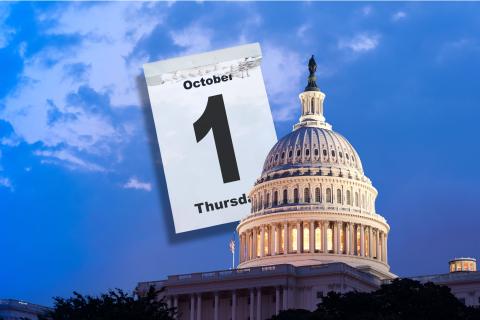
October 1 has a certain reputation in the grants world.
For weeks beforehand, forums and webinars buzz with warnings about the federal fiscal year turning over. Grantseekers refresh funding portals. Somebody's colleague swears an agency releases “a wave” of new opportunities the moment the calendar flips.
Then October 1 arrives. And for most organizations, nothing dramatic happens.
The portal looks the same. The open opportunities are mostly the ones that were already open. The inbox does not fill with urgent new solicitations.
This is not a sign that something went wrong. It is a sign that the mythology around October 1 was bigger than the reality. Understanding what the new fiscal year actually changes, and what it does not, helps your organization spend October checking the things that matter instead of refreshing a webpage.
What the fiscal year turnover actually means
The federal government's fiscal year runs October 1 through September 30. When one ends and the next begins, a few concrete things happen inside federal agencies:
- Agencies begin operating under the new year's appropriations, assuming Congress passed a budget on time
- If Congress has not finished its work, agencies instead operate under a continuing resolution (CR), which generally funds programs at the prior year's levels until a full budget is passed
- Multi-year grants and cooperative agreements may enter a new budget period, which can trigger a continuation application or a new progress report
- Program offices that were holding a funding announcement until their new-year budget was confirmed are now able to release it
- Some agencies publish an updated version of their annual funding forecast, which is worth checking even when no new announcement has appeared yet
None of this is invisible. It shows up in agency forecasts, in continuation paperwork, and in program office announcements. It does not show up as a sudden flood of brand-new competitions appearing across every agency on the same morning.
What does not reset
Your organization's history with a funder does not reset on October 1. A program officer reviewing your continuation application in mid-October is not meeting your organization for the first time. Your track record, your prior year's reporting, and the relationship your staff has built with that office all carry forward.
Your eligibility does not change because the calendar changed. Neither does the quality of the program you are proposing, or the strength of the case you can make for it.
And a new fiscal year is not, by itself, a reason for an agency to open a flood of brand-new competitive funding opportunities. Some years bring more new solicitations than others, but that has more to do with policy priorities and appropriations decisions than with the date on the calendar.
Two organizations, two Octobers
Picture two organizations that both have a report due to a federal funder sometime this fall.
- The first organization spent September watching for the fiscal year to turn over, assuming that whatever was going to happen would happen on October 1. When the date passed quietly, the team relaxed, and nobody rechecked the actual due date buried in the award's terms until a reminder email arrived with eleven days of notice.
- The second organization spent thirty minutes in September pulling up the terms of every active award, writing down the real reporting and continuation dates, and noting who owned each one. October 1 came and went without much comment, because the team already knew what actually mattered and when it was due.
Neither organization did anything dramatic. The difference is entirely in which one treated October 1 as the deadline that mattered, and which one went looking for the deadlines that actually did.
Continuing resolutions (CR) change the timeline more than the fiscal year does
If Congress has not passed full-year appropriations by October 1, the government typically operates under a continuing resolution, sometimes for weeks, sometimes for months.
A continuing resolution generally keeps agencies funded at recent levels, but it also tends to make agencies more cautious about releasing brand-new funding opportunities until they know their actual budget for the year. This is often the real reason a program you are watching seems quiet in October: not because the fiscal year turned over, but because the agency is waiting on Congress.
Checking whether your program's authorizing agency is operating under a continuing resolution will tell you more about what to expect this fall than the October 1 date itself.
What to actually check this month
Instead of watching for a wave that may not come, spend part of October on a short, useful list:
- Confirm whether your program's authorizing agency is under a continuing resolution, and what that has historically meant for its funding announcement timeline
- Review every active multi-year award your organization holds, and confirm its next report or continuation deadline directly from the award terms, not from memory
- Check the specific agency forecast page for any program you are waiting on, rather than assuming a date
- Note which staff member owns each of those deadlines, so nothing depends on memory
- If a program you rely on has not reopened by the date you expected, check the forecast page again before assuming the program was cancelled
This is not a dramatic exercise. It is a calendar check. But it is the kind of calendar check that prevents a missed continuation report from becoming a real problem in November.
The bigger picture
Federal fiscal year mechanics are useful for planning. They are not useful as a source of urgency. Understanding how appropriations, continuing resolutions, and budget periods actually interact lets your organization build a realistic sense of what is likely to happen this fall, instead of reacting to what the calendar supposedly means.
October 1 is a date on the federal government's own books. It does not have to be a source of anxiety on yours.
Just Added! Competing for Federal Grants-Online has just been added to the schedule, January 25-29, 2027. The federal government awards billions of grant dollars each year that support a vast range of services and programs. Competing for Federal Grants provides you with proven approaches and tools to tip the odds in your favor, making your grant applications more competitive and more likely to succeed. Sign-up today!
For more information about The Grantsmanship Center and our other products, visit our website: tgci.com
Get funding. Create change.